
I recently came across a powerful idea in the podcast episode featuring Greg McKeown on the Tim Ferriss podcast.
You know how you have all these ideas you want to work on, projects you want to build, goals you want to accomplish – but somehow they don’t quite get done?
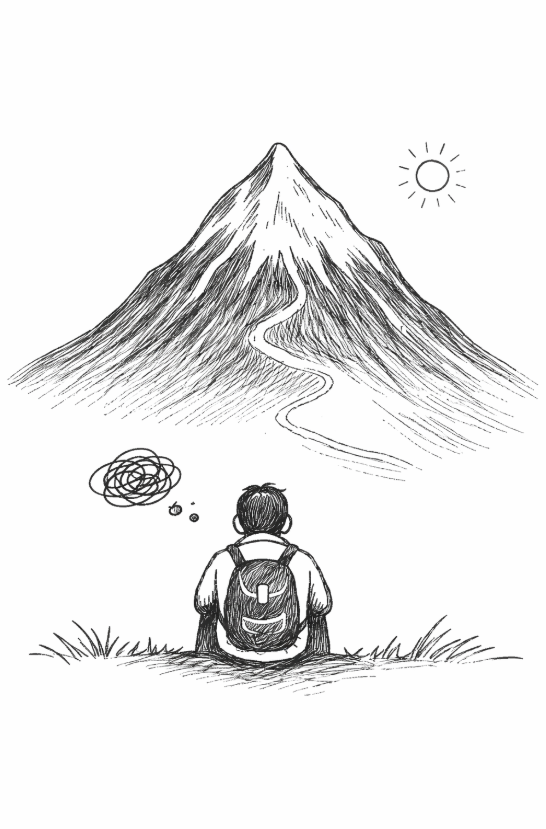
Greg shares the idea that the reason many of us struggle with this, is because a lot of us have “performance anxiety”. We’re so afraid of failing at these goals, uncovering something that would undo all these hopes and dreams, that sub-consciously we just procrastinate on working on these goals.
Here’s an excerpt from the episode (full episode and transcript here):
Greg McKeown: But what I have learned is this strange law of inverse prioritization, which is, I literally believe now that the most important thing in our lives at any given time is the least likely thing to get done, which is really strange.
Tim Ferriss: It sort of squares with what I see and what I’ve experienced at points. Why do you think that is?
Greg McKeown: I think one of the reasons is because it’s so important, the risk of failing at it is much higher than anything else in your life. So, it adds to this procrastination feeling.
Tim Ferriss: Performance anxiety.
Greg McKeown: Yes. Very high performance anxiety around that important thing because doing something about it shows that you can fail or might show that —
Tim Ferriss: It doesn’t work.
Greg McKeown: It doesn’t work. And now we’ll be back to the beginning on this thing that’s so high stakes, and then the more important the thing is, the more vulnerable it is. So then you want to avoid — we all know we should, that courage is a virtue, but courage always feels terrible. I mean, it is an awful feeling. It’s not like you imagine when you see other people being courageous.
Tim Ferriss: Courage doesn’t exist without the prerequisite of fear. Like courage does not — it’s you feel fear and you do the thing anyway. Without the fear, courage as a word and concept doesn’t apply.
Greg McKeown: Yeah. There’s lots of layers of reasons that add onto that. One is sort of pretend perfectionism that drives procrastination. Well, unless I’m going to do this perfectly, unless I’m really ready to do this, unless I’m in the perfect situation, unless I’m going to do it for the full amount of time. So all of these additional rules.
Perhaps this is obvious to you but I found this idea illuminating.
I think I have suffered from this myself. Continuously putting things off. And I don’t think there’s a conscious “fear of failure dialogue” going on in my head, but if I feel peel back the onion, I think that’s what it is. There’s a fear of finding something, realizing something, running into something – and because this goal is so important to me, there’s a lot of vulnerability associated with it.
And because this goal is so important to us, we have in mind all the work that has to be done, all the time and energy we need to spend on it. It all feels so big and monumental, and it’s never the “right” time, and as a result, we don’t even begin to make progress.
And this is where the “5 mins is better than 0 mins” idea comes in. Not letting the great be the enemy of the good. Understanding that spending 5 minutes each day making progress towards what you care about, is better than spending zero minutes and making zero progress.
Here’s another excerpt (full episode):
Greg Mckeown: And so I like the term microburst for this. That’s an environmental reality. Like these storms that are just these 10-minute storms, a microburst, but actually setting a timer for 10 minutes. And the key is that you end at the end of the 10 minutes. That’s what you’re using the discipline for.
And you say, okay, I’m going to do that. 10 days in a row, 10 minutes, and when it hits 10 minutes, I’m done. So that the next day, you know this is small, I really will end when it says so, and therefore I’ll carry it on. And there’s just almost no end to the application of that. I was just reflecting on this as I was finishing this journal. I need to get the next one. This is like in January. That will be 14 years that I’ve kept a journal, and I don’t think I’ve missed a day. I might’ve done if I went through it all, but I don’t think I have. But the reason is because my upper bound when I first started was five sentences and my lower bound was one sentence.
And what normally happens with journals is the exact opposite. First day, people write three pages, and by day two, then it’s done by day two because on day two, they’re like, “I don’t have an hour for this.” And so then they go, “Oh, I’ll do it tomorrow.” And then day three, now they’ve got to do two hours in their mind, and so it’s over before they’ve begun. So I think that’s one key thing for you is the 10 minutes. I’ve done it, 10 minutes. Until I have done 10 days in a row, I’m doing 10 minutes. It’s way, way better to do that little than to not do any because you want to do it perfectly.
Now that I’m aware of this, this in and of itself has been an unlock. I consciously tell myself “5 mins is better than 0 mins”. So – if I want to scale my journals business to the next level. Instead of just thinking about it, I have to spend 5 mins each day. One day I try to find another business owner who might have advice for me. Another day, I send one cold email. It doesn’t matter what it is, but each day, I have to spend atleast 5 mins towards my goals. Being aware that I might have performance anxiety, and telling myself that it’s ok if the vast majority of these shots do not work out.
And guess what, as you start doing small things each day, you build momentum. You no longer feel stuck and keep feeling bad about stuff not moving.
Check out this episode if you’re feeling stuck. It might just help you.
Share this:

Categories: Creativity, Daily routine, Hard work, Inspiration, Make stuff, Observations and Musings, Self improvement
 Sonali Mangal